This is the next instalment in my Investing in innovation series of blogs.
When engaging with your potential customer base, it is essential to understand your potential customers as much as possible. Not just their needs and challenges (as you might establish from a VoC analysis), but their operational corporate structures:
- How are purchase decisions made?
- Who makes them?
- What drives their need for a purchase of my solution or service?
In other words, who do I need to talk to and when if I am to maximise my chance of making a sale.
I’ll illustrate what this might mean for a supplier selling an innovative digital product to operational wind farms.
Classify your potential customers
First, we need to understand your potential customers’ approach to some key decision making areas, such as:
- How do they invest in innovation?
- What the balance between internal vs external solution development?
- How do they approach the use of innovation in the operational phase?
- What do you need to do to gain approved supplier status for 3rd party solutions?
Let’s assume we decide there are three relevant classifications for our potential customers:
A: Little or no internal development, heavily reliant on 3rd party solutions.
B: Some internal development and innovation, but with continued use of 3rd party solutions.
C: Significant internal development team, with limited use of 3rd party solutions.
Customer Profiles – Internal roles and relationships
Using the classifications developed above, we map out typical roles and relationships for each.
Category A clients:
- Head of Asset Management (HoAM) typically drives the process and should be the focus of our engagement.
- Some initial engagement success may be achieved from talking direct to site managers.
- Corporate requirements and processes are unlikely to be significant and are there to support the HoAM.
This looks like the below.
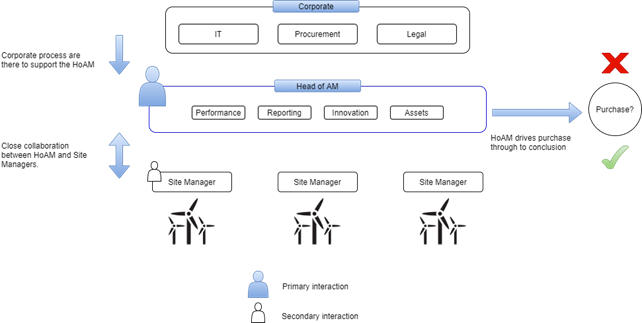
Category B clients:
- HoAM typically drives the purchase and should be the focus of our engagement.
- Some initial engagement success may be achieved from talking direct to site managers.
- Close collaboration with corporate departments will be required to complete the sales process.
- HoAM must actively support us through the corporate process in order to successfully conclude the deal.
This looks like the below.

Category C clients:
- Innovation is driven centrally at a corporate level. The Head of Innovation (HoI) typically drives the process and should be the focus of our engagement.
- Some initial engagement success may be achieved from talking direct to the HoAM.
- Corporate departments play a major role in decision (specific processes and requirements). HoI must actively support us through this part of the process to ensure success.
This looks like the below.

Customer Profiles – Engagement timelines
We can further elaborate on these relationships to build a timeline of engagement across all the relevant stakeholders. I include an example for a Class C customer below for illustrative purposes.
- HoI drives the purchase process internally.
- Initial discussions and demonstration periods likely to be significant due to translation of technical needs and interest from IT and internal development teams.
- The purchase process is likely to be the most formal of the three classes but should not require extensive engagement.
- The rollout process is likely to be short as the client will seek to take full ownership of the solution as quickly as possible.
This looks like the below.

Reflections
By taking the time to understand your potential customers’ inner workings, with particular attention to those roles that will drive the adoption of our technology, we are seeking to achieve three things:
- Clarify our approach to maximise our return on our efforts
- Gain our customer’s trust by showing we already understand your potential customers internal procedures and challenges, and, ultimately,
- Be better prepared if/when we are successful in a sale, as we will already know the processes required to complete a successful installation of our product.
This last point may be most crucial of all. We will be able to price our sale more accurately as we will already know the challenges we will have to overcome in terms of number of stage gates, number of stakeholders, etc. We are then less likely to make a loss on the deal. Consequently, the rollout phase will be smoother, leading to better user uptake and higher customer (and personal) satisfaction. There is nothing more demotivating at a personal level (and damaging at a commercial level) than a problematic installation that results in poor user uptake and high customer dissatisfaction.