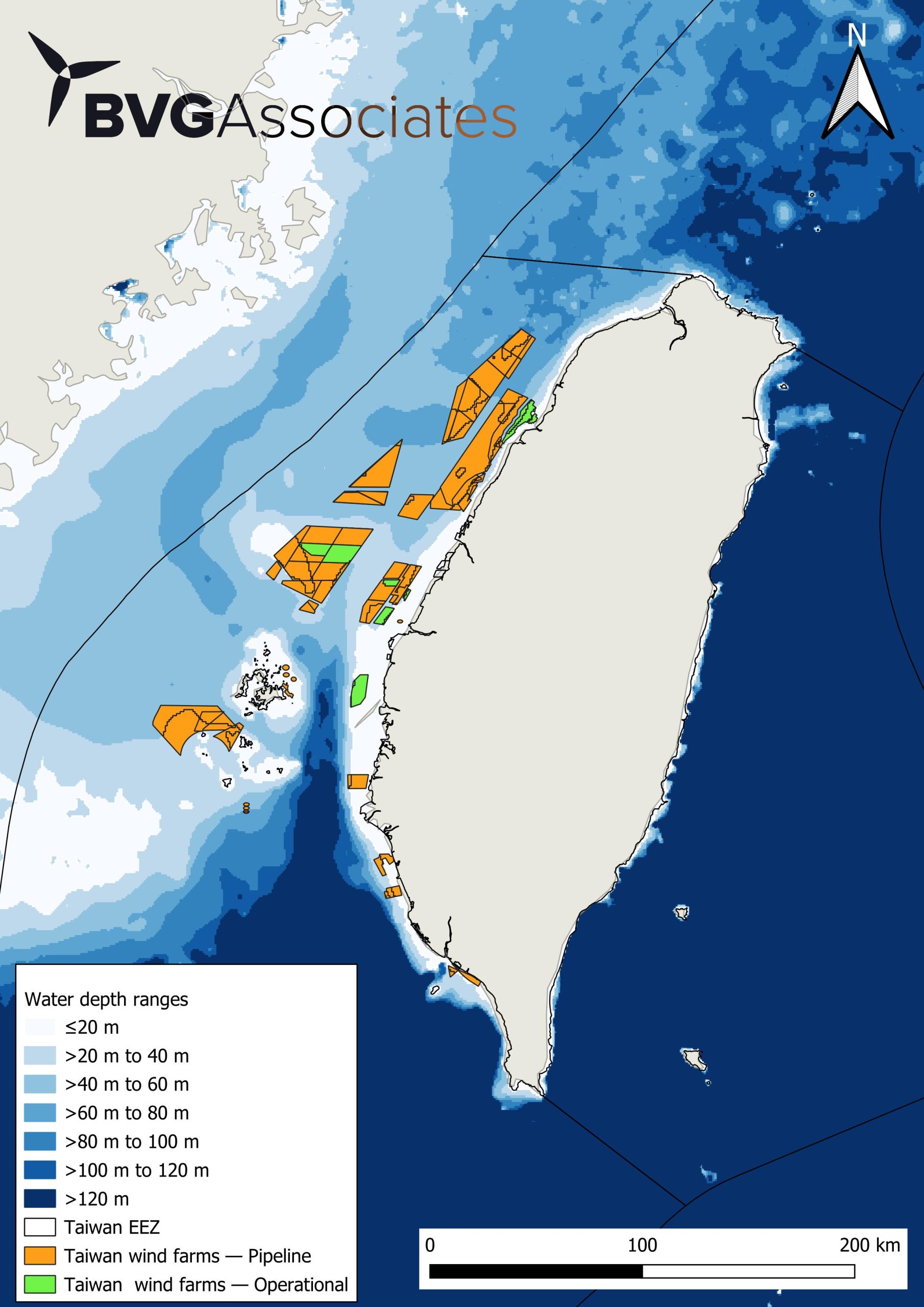
Taiwan has long been the leader in utility-scale wind deployment in the Asia-Pacific region outside of mainland China. Yet, the closing of Round 3.3 Zonal Development auction submission window last week has presented global wind markets with a clear regulatory paradox. A framework designed to be more accommodating to international investors resulted in the lowest bidder turnout in the market’s history.
The government explicitly listened to international voices. For Round 3.3, it abandoned rigid local-content mandates that previously constrained supply chain choices and therefore project economics. It also introduced a stabilising price floor. Despite these corrections, only two developers, Ørsted and Copenhagen Infrastructure Partners (CIP), entered the fray.
With 3.6 GW of capacity on offer, this duopoly means that less than half of the targeted capacity will likely progress into development. The auction allows up to a nominal 1 GW-scale project, with a potential of up to 50% uplift. A their two projects overlap and only one winner is allowed, it is hard to see how more than 1.5 GW could be awarded.
The necessary reset: What Round 3.3 got right
The previous regulatory frameworks in Taiwan had pushed the market to its limits. Mandatory localization rules drove up capital expenditure and introduced severe supply chain risks. Simultaneously, the push toward zero-subsidy bids forced developers to rely on the corporate power purchase agreements (CPPA) . This created significant revenue-side risk that spooked traditional project finance lenders.
Following the European Union’s WTO challenge, the Ministry of Economic Affairs (MOEA) initiated a vital reset for Round 3.3:
- • From mandates to ESG scorecards. Compulsory procurement was replaced by an evaluation framework covering local industrial benefit, environmental sustainability, and corporate social responsibility. This allowed the government to reward enduring Taiwanese capability without forcing uncompetitive procurement.
- • A financial floor. The introduction of a fixed support mechanism at NT$2.29/kWh (~US$72/MWh) provided a crucial financing bridge, mitigating merchant risk alongside corporate CPPAs.
For local Taiwanese banks, this NT$2.29/kWh floor is a highly welcome credit anchor. While domestic lenders remain cautious about long-term corporate credit risks in the local CPPA market, this sovereign-backed revenue baseline provides the structural predictability needed to unlock local project finance liquidity.
On paper, this represented a healthier, more mature approach to market design. In practice, the competitive element shifted to non-price criteria: track record, execution capacity, and financial scale.
The capital barrier and retrospective risk calibration
While the front door was opened by removing local content mandates, the entry requirements were bounded by high corporate net-worth thresholds and retrospective compliance metrics.
This naturally favoured large, balance-sheet-financed global utilities over smaller consortia. More critically, the scoring framework adjusted points based on historical execution issues in the Taiwan market. Previous project delays, unsigned awards, or terminated contracts result in point deducations.
In a market where every developer has wrestled with post-pandemic supply chain bottlenecks or grid-allocation friction, these tightened rules had an immediate cooling effect. At least three major international players with deep Taiwanese experience were either mathematically precluded from competitiveness or frozen out because their chosen maritime areas overlapped with legacy projects still undergoing administrative or contract termination clearances.
Ultimately, global boards faced a simple question of capital allocation efficiency. The risk-adjusted return profile in Taiwan did not justify entering Round 3.3 for the majority of the industry.
What’s next: Restoring the pipeline and looking to floating
Taiwan remains the most mature project ecosystem in APAC outside of China. It has an established installed base and highly experienced local institutions. Round 3.3, however, will not alone keep deployment on track to meet the its ambitious renewable energy targets.
To restore competition and secure a robust multi-gigawatt pipeline, the Government should act on three strategic fronts:
- Re-engage industry for Round 3.4. The volume of unallocated capacity from Round 3.3 will inevitably roll over into upcoming fixed-bottom rounds. The MOEA needs to proactively consult with industry to find the balance that gives what both the state and industry need.
- Synchronising the floating horizon. Alongside the continued expansion of fixed-bottom offshore wind, Taiwan is preparing for the emergence of floating wind. Regulations for its first demonstration projects are expected in 2027. This transition requires early, clear market signals regarding realistic timing, port readiness, grid access, and tariff structures to avoid replicating the challenges of fixed-bottom rounds.
- Converting current awards. Immediate focus must be placed on helping Ørsted and CIP convert their Round 3.3 awards into fully financed, bankable projects amidst a complex local CPPA market.
Lessons for emerging markets
For governments designing offshore wind frameworks, Round 3.3 offers direct and indirect actionable takeaways:
- De-risking is effective, but not the whole story. Removing supply chain mandates and offering revenue floors does increase market attractiveness, but these gains can be instantly neutralized by overly rigid administrative requirements.
- Calibrate retrospective hurdles carefully. Penalties that penalise developers for historical delays compress the bidder pool, stifling the competition needed to drive down costs.
- The reality of non-price criteria. Qualitative criteria like “deliverability” sound prudent, but they require highly objective calibration to avoid unintended market distortion that suppresses market appetite or skews intended outcomes.
Taiwan has proved it has the agility to correct its policy course. The challenge now is to refine those corrections so that the next auction revives investor confidence.