So, with 24 hrs to let the dust settle and a little reflection kick-in, what should we make of the AR7 results?
It feels pretty unequivocal that we should be regarding the award of 8.4 GW of offshore wind in AR7 as a “good thing”. On the back of a fairly difficult 18 months, with many projects struggling to gain momentum (and some dropping out completely – at least for now), the somewhat underwhelming initial AR7 budget of £0.9 billion had kept our ambitions in check. The expected 3-4 GW would keep things ticking over – a “sensible re-balancing of expectations” I think I described it at the time.
But Lo! Government decided to double the size of the budget (after reviewing the bids in December, utilising the advertised flex option) and here we are, gazing over more GW than we thought possible. In the east a new wind-powered day is dawning, and the light is chasing our shadows away.
AR7 is a timely win for this industry and very much to be celebrated and applauded. Government and industry have listened to and responded to each other’s perspectives. We absolutely should sit back and enjoy the feeling that positive announcements like this bring, especially after a period of sustained hand-wringing. But it’s always worth peaking behind the curtain a little to consider some of the more subtle points in the AR7 results. . .
Big is clearly still beautiful
It is commonly accepted that building at scale leads to lower LCOE – and AR7 is writing that in bold with underlining. Setting Awel y Môr aside for the moment, the winning (fixed) projects are Berwick Bank (although only 1.4 GW in this CfD round, the total project is >4 GW) Dogger Bank South (total capacity 3 GW), and Norfolk Vanguard (total capacity >3 GW). This is currently the most obvious way to keep the cost of offshore wind down. Known technology, standard processes and build as big as possible. We actually looked at the extreme end of this approach in a report we did recently for Knight Vinke (Cost benefits of very large wind farms).
To be clear, there is plenty of innovation going on in these large projects, but it’s essentially incremental. It has little to no effect on the risk profile and thus keeps the cost of capital to a minimum. Questions remain about how we better manage greater levels of innovation and its associated impact on risk (and costs), and how we keep smaller projects competitive. Generally, lower risk is a by product of greater experience, so the 8 GW addition to the UK pipeline from AR7 should have positive knock-on effects for projects bidding into future ARs. Consequently Awel y Môr’s win, as a sub 1GW project, deserves great credit when seen from this perspective.
It’s hard being Scottish
The AR7 framework explicitly allowed for Scottish projects to have a clearing price independent of English and Welsh projects. This was pre-empting the expectation that Scottish projects would have higher bid prices due to significantly higher use of system (TNUoS) charges. Although all fixed offshore projects were competing in the same pot, the “Scottish maxima” rule ensured that the overall budget was used as efficiently as possible.
So Berwick Bank, in the absence of any other successful Scottish projects, has effectively set their own price, 2% lower than the clearing price for the others. Perhaps not quite what the rule was introduced for, though with more Scottish projects expected in subsequent rounds I’m expecting this very sensible rule will remain.
It’s still slowly slowly with floating
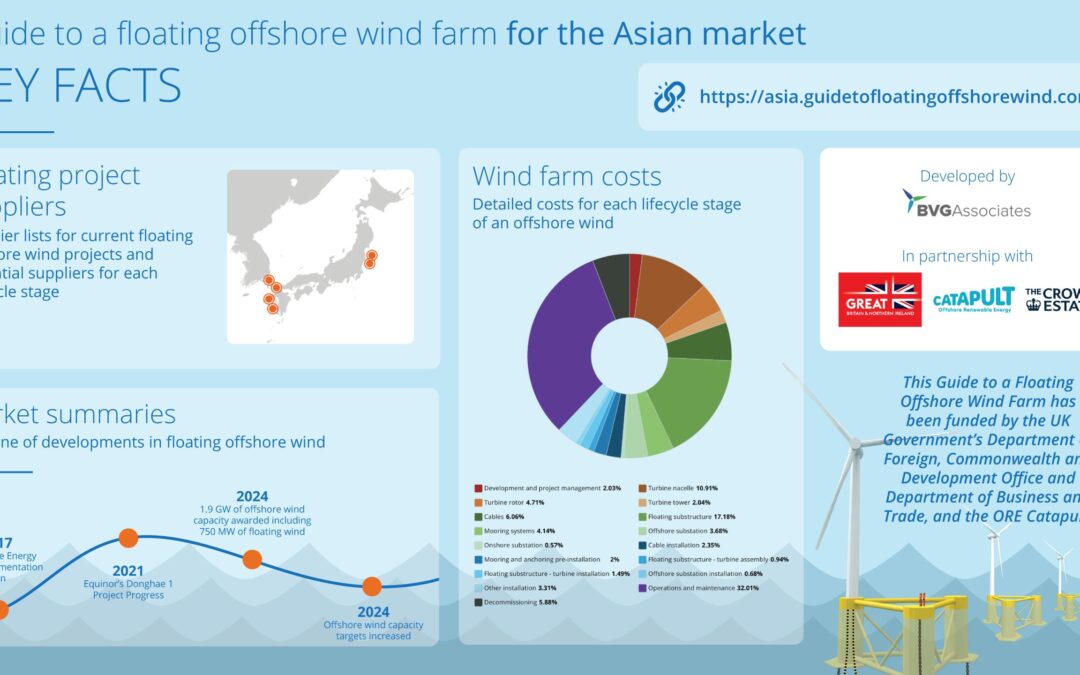
There is some tempering of celebration on the floating front with only two projects gaining AR7 contracts, out of four eligible floating projects. This keeps things moving forward, but industry sentiment is that floating needs to step up a gear in terms of volume and industrialisation in order to demonstrate deliverability and bring prices down.
The strike price of £216/MWh does not compare favourably with the prices obtained in France’s AO5 and 6 auctions. The structural support of floating in France is quite different to the approach taken in the UK – perhaps we should be reviewing our approach to give floating more of a leg-up in this race?
The geographical split of the two projects (north Scotland and southwest England/Wales) has the upside of spreading the opportunity, but a focus on consolidating and industrialising around a centre of gravity would likely bring greater results quicker.
With floating such a major contributor to our overall pipeline – and the associated potential for the UK becoming a genuine world leader in the technology – leaving it to individual projects and a price-driven auction process may prove to be a high-risk low-reward strategy.
Fragmented bidding
Vanguard’s approach of bidding the majority of their capacity at one price followed by two small incremental bits of capacity (presumably at higher price levels, though obviously we don’t know) is worthy of note – it would be interesting to understand more about this.
Flexible budgets
The ability to flex the AR7 budget was made clear beforehand, but the scale of flexing has been a surprise. It is a smart move to retain flexibility – promising low and delivering high gives good vibes, but one wonders how often this can happen. How might projects bid in future auctions if budget flexibility is retained – does it weaken competitive tension? My expectation is that there will be little, if any, adverse impacts on future bids if this approach is maintained, and that some budget flexibility will be built into future ARs.
There also is the question of where the “extra” budget came from – at least some it presumably came from the unused budget of AR6, so flexing to this scale may be simply a one-off opportunity used wisely.
Supply chain
An additional 8.4 GW into the pipeline from AR7 is something that the supply chains can really get their teeth into. The question now is how best to support them make the financial commitments to step up and be ready for the opportunity. Training, investment, strategy are all key parts of this equation, as is strong collaboration with the developers and their Tier 1 suppliers.
RWE
Let’s face it – they played a blinder. Huge respect to the whole team. The effort and imagination required to get these massive projects down to lower costs that are also de-risked (meaning bankable propositions with low cost of capital) – and across several different project teams – is not to be underestimated.