Romania has reached an important milestone in developing offshore wind in the Black Sea. On 27 August 2026, the Romanian Government approved a first list of offshore wind concession areas. The areas were identified through a technical cooperation project led by BVG Associates. InvestEU funded the project and it was delivered under the European Bank for Reconstruction and Development’s (EBRD) Renewable Energy Market Accelerator programme.
We delivered the project in close cooperation with Romania’s Ministry of Energy and subcontract partners. We identified initial offshore wind concession areas with 3.1 GW capacity and potential future concession areas to enable further investment. The project also contributed to an important milestone under Romania’s National Recovery and Resilience Plan.
What the project involved
The project involved identifying potential concession areas through sensitivity mapping of a wide range of biodiversity, social and technical attributes. Attributes included legally protected biodiversity areas, fishing grounds and shipping routes. Combining this sensitivity analysis with spatial levelized cost of energy modelling identified the most economically attractive areas with sufficiently low sensitivity. Such areas have a good chance of being permitted following detailed project-specific Environmental and Social Impact Assessment (ESIA).
The work included GIS analysis, review of spatial datasets and stakeholder engagement. Engagement with experts, relevant agencies and the public was through written feedback, face-to-face workshops and sector-specific meetings. The project team also commissioned and interpreted wind resource studies and supported legal aspects of reaching formal Government Decisions on Romania. Output was in the form of editable spatial data, static maps and substantial reports in English and Romanian.
Delivering at exceptional pace
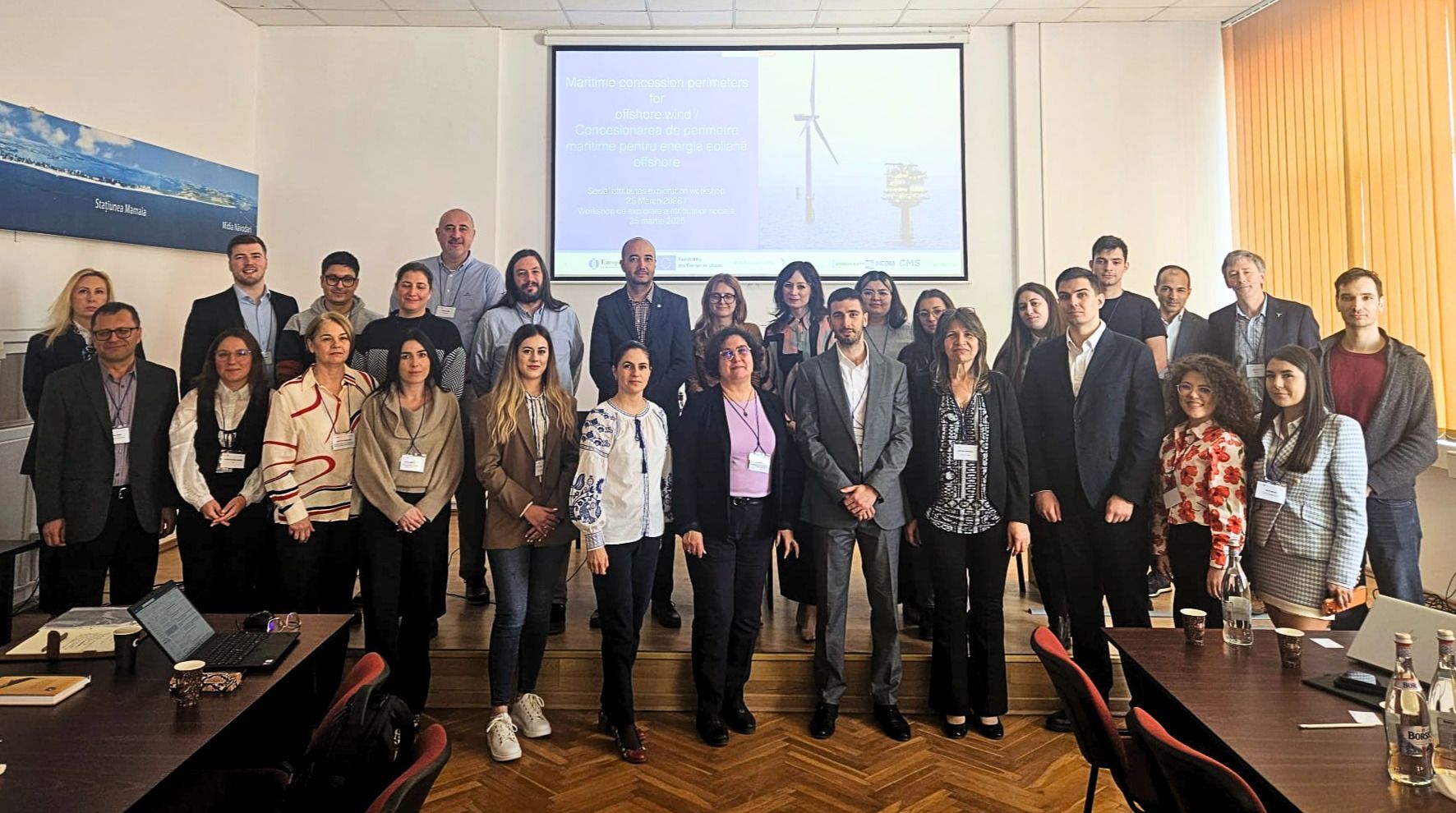
The formal kick-off took place on 12 February 2026. An introductory webinar for stakeholders followed on 9 March. In-person, day-long exploration workshops were held later that month. Early perimeter options were already discussed by 19 March. A further round of validation workshops in April led to further input and refinements. Almost-final plans were delivered after a further round of input and validation by the end of June. Formal ministerial and public consultation helped finalize concession areas before the final Government Decision on 27 August. In less than seven months, the project moved from mobilisation and evidence gathering to approval of concession areas.
That pace created real delivery challenges. Important datasets only became available after the analysis had started, sometimes close to workshops or decision points. Each new input had to be reviewed, documented and incorporated. Proposed perimeters had to be developed early enough to support productive discussion while remaining responsive to stakeholder feedback and new data.
The timescale also required environmental, social, legal and technical workstreams to progress in parallel with cost modelling and wind resource assessment. Maps, reports, metadata, consultation responses and bilingual material all needed to remain aligned as conclusions evolved.
What made it work
A key success factor was that our team had a clear and viable process in mind from the start, learning from our work in other markets. The team always took early action in anticipation of upcoming challenges. This enabled space to react quickly to beneficiary requests. We had confidence to use draft sensitivity mapping and perimeters to provide a practical basis for workshops and decision making. Workshops included times for Q&A and learning, recognizing that much of the content was new to many.
Close collaboration was equally important. Regular communication between EBRD, the Ministry of Energy and the project team helped address key questions early and focus effort on the most important decisions. Engagement with Romanian institutions improved the evidence base and helped create shared understanding of different sea uses and interests.
We experienced much goodwill from many stakeholders and received rapid responses from the Ministry of Energy and EBRD. We also developed actions for project development following concession award that have a solid basis, especially ensuring fair treatment of stakeholder groups, such as fishers, and protecting biodiversity.
Lessons for emerging offshore wind markets
The project reinforced three lessons:
- Speed comes from an experienced team working flexibly with a committed beneficiary and funder, all with the same end goal.
- Inclusive spatial planning works best as an iterative dialogue supported by maps and transparent evidence, allowing time for listening and adaptation.
- Rapid delivery needs discipline, tidiness and strong information management to keep many connected outputs aligned.
Romania now has an approved starting point for taking its first 3 GW of offshore wind potential to market. Much work remains before projects are built, but moving from project kick-off to approved concession areas in under seven months shows what focused collaboration can achieve.