The budget notice for Allocation Round 8 (AR8) has been published, and anyone hoping for clarity about what this might mean for future volume of fixed offshore wind coming forward will be disappointed.
In an unprecedented move, the Government has set pot budgetary values at a nominal £1. The peppercorn budget is aimed at sharpening developers pencils ahead of bids into the round, with the budget announcement bluntly stating: “Budget will only be provided if bid prices are in consumers’ interests”.
As with AR7, AR8 budget notice rules allow ministers to consider increasing budgets where bids that would have otherwise exceeded the original budget represent acceptable value for money. Government has been clear that the substantial uplift seen in AR7, where the pot size doubled from an initial £900 million to a final £1,800 million, should not be assumed to be the norm.
AR7 supported more than 8 GW of fixed-bottom offshore wind, but AR8 arrives against a different political backdrop with stronger emphasis on the system cost of new generation. Network costs and generation subsidies now make up around 46% of the annual cost of electricity for an average UK household. The intent to bring significant new renewable energy capacity online to support decarbonisation remains clear, but it needs to be balanced with economic realities.
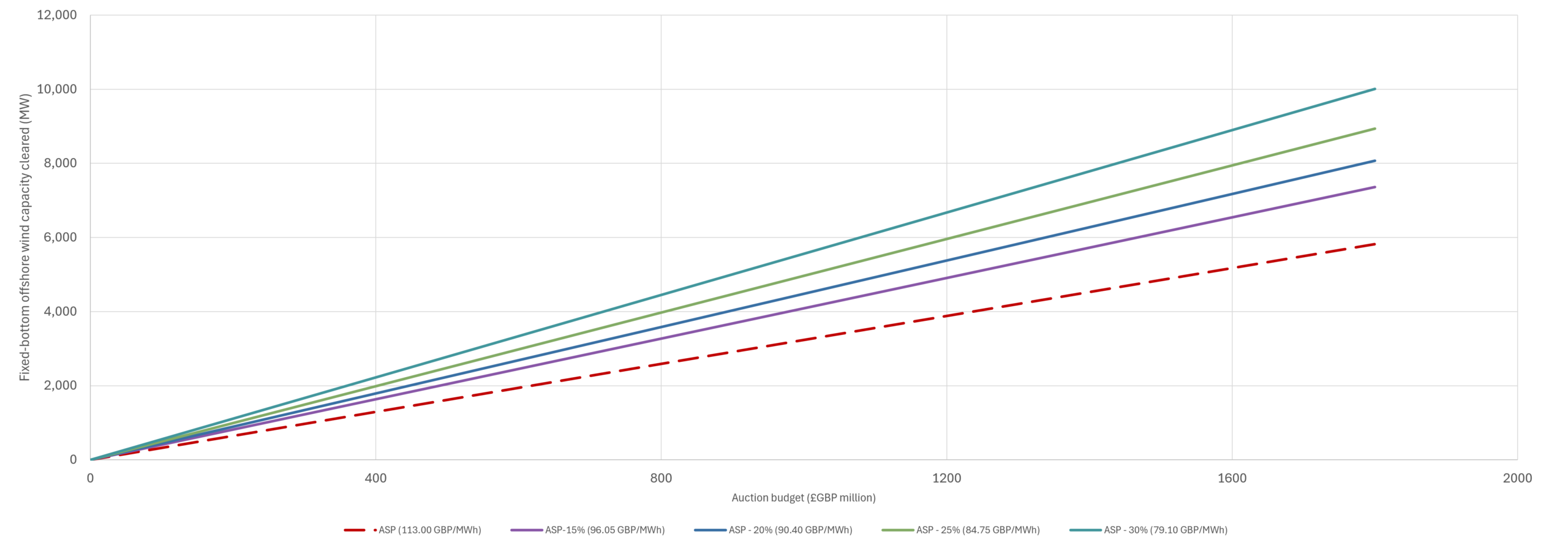
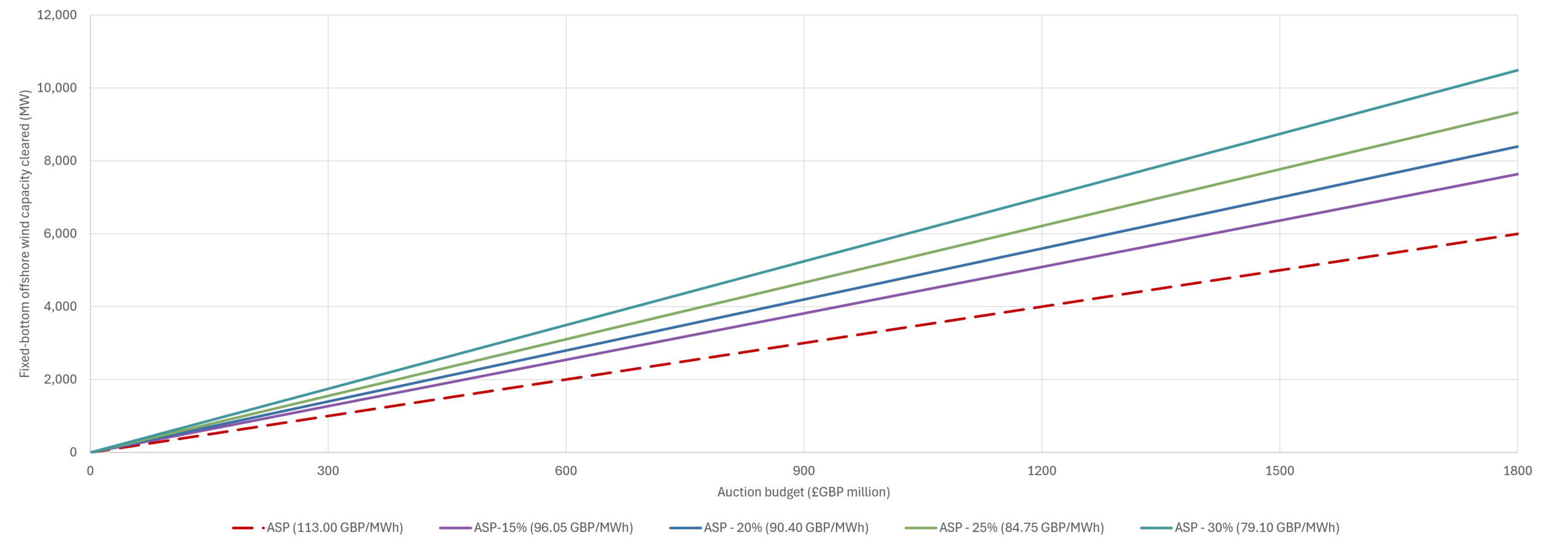
Such a low budget makes predictions difficult, but the graph below shows how much capacity can be secured at a given clearing price. My best guess for where we will end up is with something between 2 GW and 5 GW clearing the round.
CfD auction – capacity cleared by budget
Each line is a strike-price scenario. Uses the existing annual cost per MW; assumes a uniform clearing price and no project or supply constraints.
Fixed-bottom offshore wind projects compete separately in Pot 3. The administrative strike price (ASP), the maximum price at which projects can bid, has been set at £113/MWh in 2024 prices, unchanged from AR7. Except for AR5, projects have historically cleared below the ASP In AR7, fixed-bottom offshore wind cleared at £89.49/MWh in Scotland and £91.20/MWh across the rest of Great Britain, around 21% and 19% below the ASP respectively.
Government has signalled a pause before the next allocation round (AR9) to consider whether more substantial changes to the CfD mechanism are needed to ensure it remains fit for purpose. The test for any reform of the CfD mechanism will be whether it can deliver better value for consumers without undermining the investment certainty needed to keep projects moving.
Key dynamics to watch
Almost 17 GW of fixed-bottom offshore wind capacity is eligible to compete in AR8, I expect the capacity that bids will be lower however, at around 10-12 GW. But either way there will be a good degree of competitive tension working to push bid prices down.
The pipeline of likely bidders contains an interesting mix of projects originating from different seabed leasing rounds. Three projects totalling 3.5 GW of capacity that could compete in the round secured seabed rights through The Crown Estate Leasing Round 4 (LR4). These projects have incurred substantial option-fee costs while progressing through development and consenting.
This could become one of the important dynamics in AR8. Projects carrying higher development and seabed costs have less flexibility when attempting to secure a CfD at a price that supports their investment case. More mature projects originating from earlier leasing rounds or lease extensions are in a different position.
As in AR7, AR8 separates fixed-bottom offshore wind into two geographic clearing-price groups The rules distinguish transmission tariff zones 1–12 and associated distribution areas from transmission tariff zones 13–27. Essentially this mechanism is there to distinguish between Scottish and Rest of GB projects. The separate clearing prices seek to improve budget efficiency by recognising differences in project costs between the two regions, preventing Scottish projects from setting the price across the whole of the UK.
Within each group, the auction operates on a pay-as-clear basis. Successful projects therefore receive the clearing price established by the marginal project required to clear within their group, rather than simply receiving the price at which they individually bid.
This creates an interesting strategic position for some of the more mature projects outside Scotland that were created via Leasing Round 3 and the Leasing Extensions process. They have an incentive to bid competitively enough to ensure they clear, but they stand to benefit significantly from a higher awarded strike price if a more expensive LR4 project clears. This dynamic have already played out in AR7, when rest of GB capacity cleared higher than Scottish capacity, but it is difficult to say for certain, as project bid prices are a very closely guarded secret, even within developers.
With Government now signalling a pause before AR9, projects that fail to secure a contract in AR8 could face a longer and less certain route to their next opportunity for a CfD. This will influence how low projects are willing to go to secure support this time out. It may also have ramifications for those projects that fail to clear the auction this time. Potentially, we might even see some degree of divestment or potentially even mothballing of projects within the crop of unsuccessful auction bidders.
So then: a crowded field, high competition, high stakes and a more than a little uncertainty – all par for the course in the always interesting world of UK offshore wind.
Results are due between Feb 15 and Feb 17 2027.